

I love coffee. Love. It. Like most things that I love, I have cultivated very specific ideas and tastes about coffee. My morning regimen is calculated and has been perfected after years of experimentation with different processes and ingredients. Now, I share it all with you.
Coffee is a big deal in my family and always has been. I dare say my father can’t go more than an hour or two without taking down a cup of mud and nobody is interested in seeing what happens if we put him to the test. We’re not talking about a crappy cup of Dunkin’ Donuts shit either. Being European, my house always had good, strong coffee.
Growing up with good coffee prepared me well for my jobs brewing it as a professional: first working at Sexy Sadie’s coffee shop in Pasadena and later working at the coffee bar in a movie theater in Santa Cruz. I really cut my teeth at Sexy Sadie’s, and the owner taught me a lot about the difference between good espresso and okay espresso.
She taught me that one of the most important things you can do to ensure a fine brew is to keep things clean. Never use anything twice without cleaning off all of the residue from the last brew. Never. This is a major problem with automatic coffee makers. You can’t clean all the parts easily and you eventually start missing out on the whole flavor that the bean has to offer.
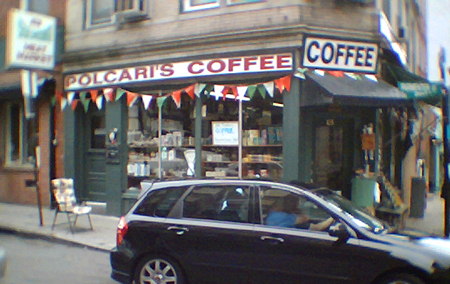
Speaking of beans, don’t skimp on the beans and always buy the appropriate beans for your brew method. I make a special trip to Boston’s North End every few weeks just to buy coffee from Polcari’s Coffee and spices. Polcari’s is run by a few old school Italian guys who do everything by hand. It’s cash only and you’re likely to spend some time behind an old lady bantering in Italian with them, but you don’t go just for just the coffee do you.
On my first visit I pleaded my case to them, “I have a stove-top espresso maker, and I just can’t find a roast dark enough to get the right color and robustness of flavor that you get out of an espresso machine.” The guy behind the counter responded with, “I’ll take care of you,” in a way that made it seem like he’d heard that line from a hundred people before me. My mornings have not been the same since.
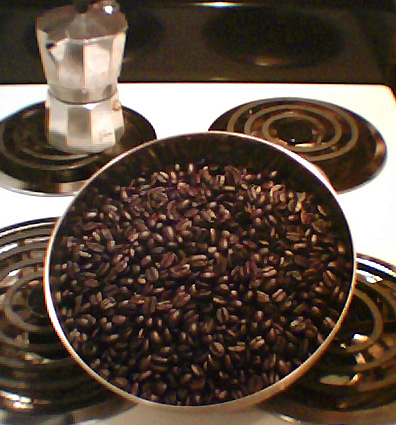
The picture at the top is a little grainy so you probably can’t tell, but they sell the darkest roast I’ve ever seen. Their Italian Roast is pitch black and is so fresh it looks like it’s been sprayed with Olive Oil. It’s also dirt cheap at $7.50 a pound. Somehow they manage to roast the beans super long without sacrificing any flavor and letting too much sugar caramelize. The caffeol (coffee bean oil) that you see on the outside means you are getting the beans just a day or two after roasting. I can’t say enough about the coffee these guys roast: the blend, the roast, everything is perfect – even the price.
Okay, now it’s time to talk equipment. An espresso machine is probably the best way to get an awesome shot every morning. However, they are WAY overpriced and a helluva lot of work to prep and clean in the morning. I’ve tried French presses of all kinds and they worked pretty well, but regular coffee just couldn’t compare with a shot of espresso. I finally settled on a stove-top espresso maker and I’ve been extremely satisfied with it for the last couple years. Dollar for dollar, I don’t think you can get a better shot.
Right now I just use a regular blade grinder to grind my beans. I’m keeping my eye out for a burr grinder on craigslist, but I’m satisfied with what I have now. I manage with pretty good consistency and give the beans a break or two so they don’t heat up. As long as you know your grinder, you can do well.
The important thing is to grind just before brewing. Grinding days or weeks before you brew results in a very noticeable reduction in flavor- even just the night before. It’s not always convenient to do in the morning, especially before you’ve had your coffee, but it’s well worth the added effort.
Finally, I use a long-handled milk warmer, thermometer, and a handheld milk frother for milk texturing. Cooking stores sell these milk frothers for $10 – $20, but I got mine at Ikea for $1.99. I don’t suggest you pay much more than that because there’s not much to them. I also recommend a handheld frother over a pump-and-pour frother. I’ve never had satisfying foam from a pump-and-pour frother.
Heating and frothing the milk is an art unto itself and there’s probably an endless supply of better educated resources for milk texturing on the web. However, this is about how I do things. So here’s what I do.
I drink a Latte every morning which, while not as difficult as making a cappuccino, takes a concerted amount of effort to achieve correct texturing of milk and foam. First, I heat the milk pretty slowly, starting with whole milk straight out of the fridge. Whole milk is easier to froth and gives much better consistency than low-fat or nonfat milk. Soy milk is a sacrilege.
Once the milk has passed 100 degrees Fahrenheit I submerge the frother in the milk to give it some volume. I pull it off the heat by about 140 150 degrees (it’ll heat up just a little even after taken from the heat). It’s time to start making foam and I pull up on the frother, just to the top of the milk, to get the smallest bubbles in there. No droopy foam is acceptable. Once I have enough, I tap the milk warmer on the counter and give it a swirl to get rid of all the bigger bubbles in it. Now it’s ready.
By this time I’ve pulled a perfect shot from my espresso maker and loaded up my mug. Perfect means about a 25 second brew from start to finish on my 2 shot model. It also means a super dark liquid with a copper colored crema at the top. Also, use filtered water if you live in a city like Boston where the tap water tastes like quarry runoff.
I stir my sugar into the shot first, then add my milk. This is just an aesthetic choice because it looks nicer if I don’t stir at the end. I top it off with milk foamed just about to hard peaks. It’s a beautiful sight. I took me a long time to get here. In fact, it wasn’t until the last 6 months where I thought I’d really reached my potential as a barista in my own home. Finding the right beans, the right grind, the right tamper pressure, the right brew equipment, and getting it right consistently has taken years.
Why spend this kind of time on a cup of coffee? It is a profound satisfaction to start each day with a ritual that yields such a refined and personalized product– my morning Latte. My coffee tastes like my coffee and no one else’s. I have put forth these efforts because I realize that my life is profoundly enriched by the ritual, and the experience of starting off each day with the appreciation of such an exquisite beverage. A fact made sweeter because my own commitment to excellence is responsible for that pleasure.
Leave a Reply